


0300 124 5082
Your Savings With GGRS
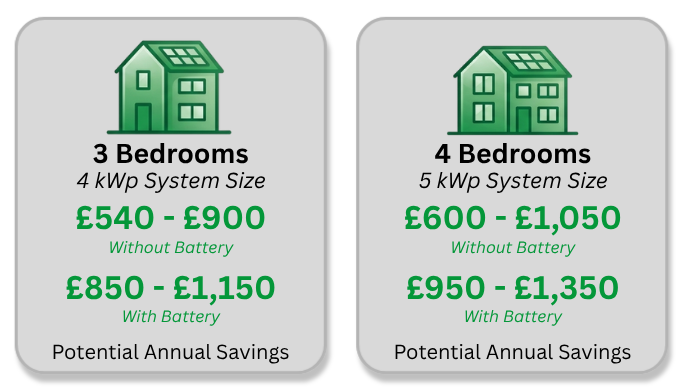
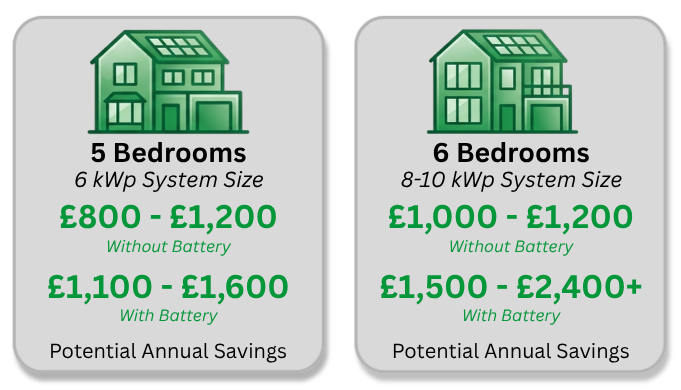
Take total control of your energy costs by powering your life with solar-generated power.
Calculating your potential savings involves balancing your current grid usage against a high-output GGRS system and smart battery storage.
Based on our extensive installation data, here is a breakdown of the long-term financial benefits you can expect based on your property size.
*Figures are based on illustrative UK national averages. See our full Calculation Assumptions & Disclaimers below.
Contact us for a 100% free, no obligations quote
Improve Your Home with Clean, Affordable Energy
Rising energy costs shouldn’t dictate your lifestyle.
Our domestic solar solutions allow you to generate your own clean, renewable electricity, giving you the freedom of energy independence while supporting your household budget.
We offer a full range of domestic solar services designed to save you money and improve your energy efficiency.
Reduce energy bills year on year with efficient solar solutions tailored to your home.
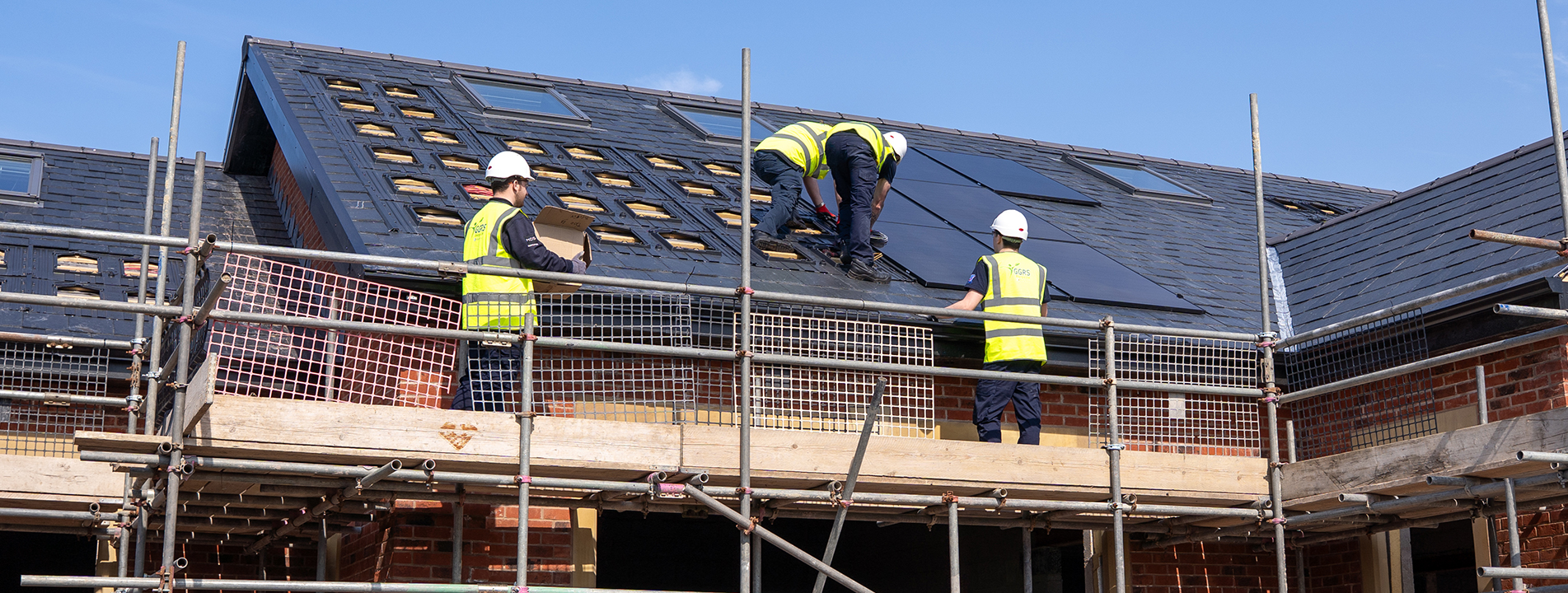
Our staff handles the entire journey, from a free survey to a professional installation, including coordination with your electrical grid supplier if required.
You can achieve energy efficiency by pairing premium panels with our 5.2kWh battery systems.
Fully accredited [by MCS and NAPIT] and built for the UK climate, we make going green simple, honest, and immediate.
- Reduce your energy bills from the moment we switch on.
- Pairing solar with a 5.2kWh battery can increase your solar self-consumption*
- Increase your home’s EPC rating.
- UK-based installers with years of specialised installation experience.
*Levels may increase by storing daytime solar generation for use in the evening. Outcomes vary depending on size, energy usage, and seasonal conditions.
- Free no-obligation quotes.
- We design a system by selecting the best roof directional facing your specific sunlight exposure.
- We only install high-efficiency panels and battery systems.
- Our UK team is with you every step of the way.
Transform your roof into a powerhouse and enjoy lower bills and a more efficiently powered home.
Instant Savings
Reduce your annual energy bills.
Focused Installation
Our teams complete most domestic instals in two days.
Energy Generation
Achieve greater energy independence.
Fast Payback
Our systems offer an average payback period of 3-4 years*
*Payback estimates are calculated using OpenSolar based on your specific utility rates and site conditions
Contact us for a 100% free, no obligations quote
How long does the installation take?
1 - 2 days but the overall process 6 - 8 weeks.
Do I need planning permission?
In most cases, no.
Most domestic solar installations fall under "Permitted Development" in the UK.
However, if you live in a listed building or a conservation area, different rules may apply.
Don't worry, our team will assess this during your initial survey and guide you through any necessary steps.
What happens on cloudy or rainy days?
The efficiency of solar panels has steadily increased over the decades from being able to produce 130kWh in 1980 to 460kWh in 2026.
They continue to produce power even on overcast days. In fact, rain is helpful, as it provides a natural "rinse" to keep your panels clean and performing at their peak efficiency.
How much maintenance do the panels need?
Solar panels have no moving parts, making them extremely low maintenance.
Depending on local environment including dust pollution. Manufacture's recommend an inspection once per year.
Will I still have power during a power cut?
Standard solar systems are designed to switch off during a power cut for the safety of engineers.
However, GGRS can design your system with a specific battery backup system that allows you to ‘island’ your home, keeping your essential appliances running even when the rest of the street goes dark.
Adding a 5kWh battery typically increases the total cost of a standard solar-only system by 50% to 80% but it can double your annual electricity use*
*Cost and savings estimates are site-specific. Figures are an estimate produced using industry standard modelling software (OpenSolar) and are subject to specific survey and design conditions.
Bill Savings
Generate your own power and lock in lower costs. The average system provides an annual output of 4,015kWh. That’s the equivalent of providing the energy for 4,000+ full cycles of a washing machine or 1,600+ hours of cooking time with an electric oven.
The average UK household can see a yearly energy bill reduction. By generating this power yourself, your locking in these lower costs for the 25 – 30 year lifespan of your panels, protecting your household from future grid price spikes.
Carbon Footprint
Make a measurable impact. Switching to solar allows the average home to cut its carbon emissions by 1 to 1.5 tonnes of CO2 every year - the equivalent of planting 75 trees*. Furthermore, solar offsets its own manufacturing footprint in less than 12 months*
Providing a clean, silent, and renewable energy source that offsets its own manufacturing footprint in less than 12 months.
*Carbon saving estimates are based on site-specific production data calculated using OpenSolar, which has been independently validated for accuracy by National Renewable Energy Laboratory (NREL) and (PV Evolution Labs) PVEL .
*Heatable Solar Advice (2024) and NREL PV FAQs, confirming that modern high-efficiency PV modules typically achieve a carbon/energy payback in 4–12 months.
Incentives
Take advantage of government support. With 0% VAT on installations until 2027 and the Smart Export Guarantee (SEG) that may allow households to receive payments eligible surplus electricity exported to the grid. Financed benefits will vary depending on system size, energy usage, tariff and supplier terms.
Energy Independence
Take charge of your energy usage. Solar panels paired with battery storage can help reduce reliance on grid electricity and may help protect against rising energy costs.
Depending on system design, property characteristics, and energy usage, some households may significantly increase their level of energy self-sufficiency.
Levels may increase by storing daytime solar generation for use in the evening. Outcomes vary depending on size, energy usage, and seasonal conditions.
*Sources & Calculation Methodology
Our savings estimates are calculated using standard models aligned with the Microgeneration Certification Scheme (MCS) guidelines and data profiles from the Energy Saving Trust (EST). Grid electricity rates are pegged to the active Ofgem Price Cap.